
When we think of Michelangelo, we think of genius: the sculptor of David, the painter of the Sistine Chapel ceiling, the man whose name is practically a synonym for Renaissance brilliance. But he wasn’t just a distant “master” from history books. He was human — proud of his work, sensitive to criticism, and not above a little bit of revenge.
And one day, a critic discovered just how dangerous it could be to offend an artist whose canvas was the wall of the Sistine Chapel itself.
The Setting: The Last Judgment
In the 1530s, Michelangelo was asked to paint a massive fresco on the altar wall of the Sistine Chapel — The Last Judgment.

This was not a soft, decorative scene. It was intense, dramatic, and full of movement: Christ at the center, angels blowing trumpets, saints rising to glory, and sinners dragged into hell.
Michelangelo filled the wall with muscular, twisting figures, many of them unclothed, showing humanity at its most vulnerable when facing divine judgment. For some viewers, it was breathtaking. For others, it was… too much.
The Critic Steps In
One of the most vocal critics was Biagio da Cesena, the Papal Master of Ceremonies. After seeing the fresco, he remarked that such a display of nudity was “more fit for taverns and bathhouses than a papal chapel.”
Now imagine being Michelangelo in that moment. He had spent years on scaffolding, straining his back and pouring his heart into this enormous work. And instead of admiration, he got compared to tavern art. It must have stung — and you can almost picture him deciding he wasn’t going to let that insult slide.
Michelangelo’s Creative Revenge
Michelangelo didn’t argue with Biagio in person. He had something much more effective at hand: paint. Quietly, and perhaps with a small smile, he returned to his fresco and gave his critic an unforgettable role.
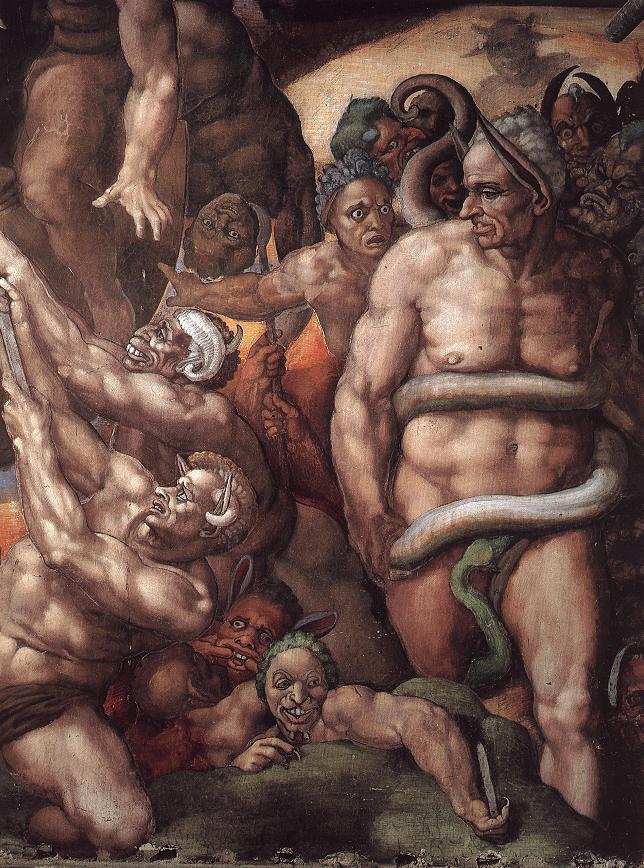
On the wall of The Last Judgment, among the damned souls tumbling into hell, Michelangelo painted a figure with Biagio’s face. To drive the point home, he added donkey ears — a Renaissance symbol of foolishness — and a serpent coiled around the body.
Anyone who knew Biagio could recognize him. It was Michelangelo’s way of saying: you think my art belongs in a bathhouse? Fine — now you belong in hell.
The Outcry
When Biagio spotted his likeness on the wall, he was horrified. He hurried to Pope Paul III and demanded that Michelangelo be ordered to paint over it.
But the pope had a sense of humor. His response was simple: “My authority does not extend to hell. You must remain there.”
And that was the end of the matter. The insult stayed, and Michelangelo had the last word — or rather, the last brushstroke.
Why This Story Still Matters
What makes this tale so delightful is not just Michelangelo’s boldness, but the way it captures the human side of great art. We often imagine masterpieces as distant and untouchable, but here’s a reminder that behind them were very real people, with tempers, egos, and rivalries.
Michelangelo’s fresco is one of the most profound works of art in the world, yet hidden within its soaring vision of divine judgment is this small act of very earthly revenge. Millions of visitors still see it today — a little private quarrel preserved forever on one of history’s grandest stages.
It shows that even the greatest artist of the Renaissance was still human — and sometimes he used his brush to make a point.
 Dreamy Penguin